
Systems Designed for Independence
Systems designed to function after support ends.
EDGE5 designs land-based systems and capability frameworks for long-term function under real operating conditions.
Systems are evaluated against water, labour, governance, maintenance, and operational constraints that emerge after implementation and handover.
Success is what remains after exit.
Why EDGE5 exists
Most systems are designed to deliver. Few are designed to survive independence.
Most land-based systems fail after handover.
Not during funding.
Not during implementation.
Failure occurs when systems face real conditions:
- reduced labour
- limited water
- no external oversight
What makes EDGE5 different
Design determines survival
Most organisations focus on building systems. EDGE5 focuses on whether those systems will survive.
Constraints, not intentions
Design is based on water, labour, time, and season. Not targets. Not assumptions.
Post-handover is the test
Systems are judged only by whether they continue functioning without support.
Authority transfer, not dependence
Systems must be operable, maintainable, and adaptable locally.
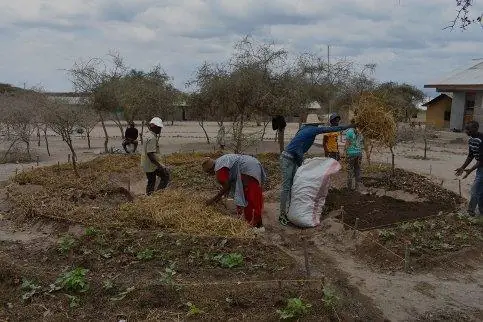
Documenting the method
Mandala garden system under construction — dryland site, Tanzania.
Designed to function within real labour and water constraints from day one. No ongoing external support required after handover.
This is not documentation of a project.
It is documentation of a method.
The EDGE5 standard
A system is only considered successful if it can meet all five conditions:
Operate without external support
Maintain function under real conditions
Recover from disruption
Transfer knowledge locally
Continue beyond the original project lifecycle
Founder
EDGE5 is led by Greg Knibbs, an Australian systems designer with over 30 years of international experience.
His work focuses on:
- land-based system design
- post-handover performance
- food and water system viability
- field implementation under real constraints
Systems developed under this approach have remained functional years after implementation, without external support.
This is not a project outcome.
It is a design outcome.
Field Partnership — David Spicer
EDGE5 works in partnership with David Spicer — a land restoration specialist with deep field experience in water harvesting, earthworks, and landscape rehydration.
David trained directly under Bill Mollison and managed Mollison's farm — then Geoff Lawton's — implementing the physical systems that make land restoration work at scale.
Together, Greg and David bring the complete picture:
- whole-system design and post-handover viability — EDGE5
- earthworks, water harvesting, dams, swales, and roads — David Spicer
David's field experience spans Morocco, New Caledonia, and across Australia — some of the most demanding landscapes in which land restoration and rehydration earthworks have been implemented.
When both are engaged, the design and the physical implementation are aligned from the first day.
docspice.life →Handover is not a date.
It is a system classification.
Used where failure after handover is unacceptable.
Begin Viability Assessment →